A Grantham engineering firm invented the world's first practical tracked vehicle in the years before the First World War, only to see the technology slip across the Atlantic and make a fortune for an American rival.
Richard Hornsby & Sons, one of the town's great engineering firms and a well-established maker of oil engines and agricultural machinery, developed the crawler track under the direction of David Roberts, the company's chief engineer and managing director. Roberts patented his "chain track" design in 1904.
The Innovation
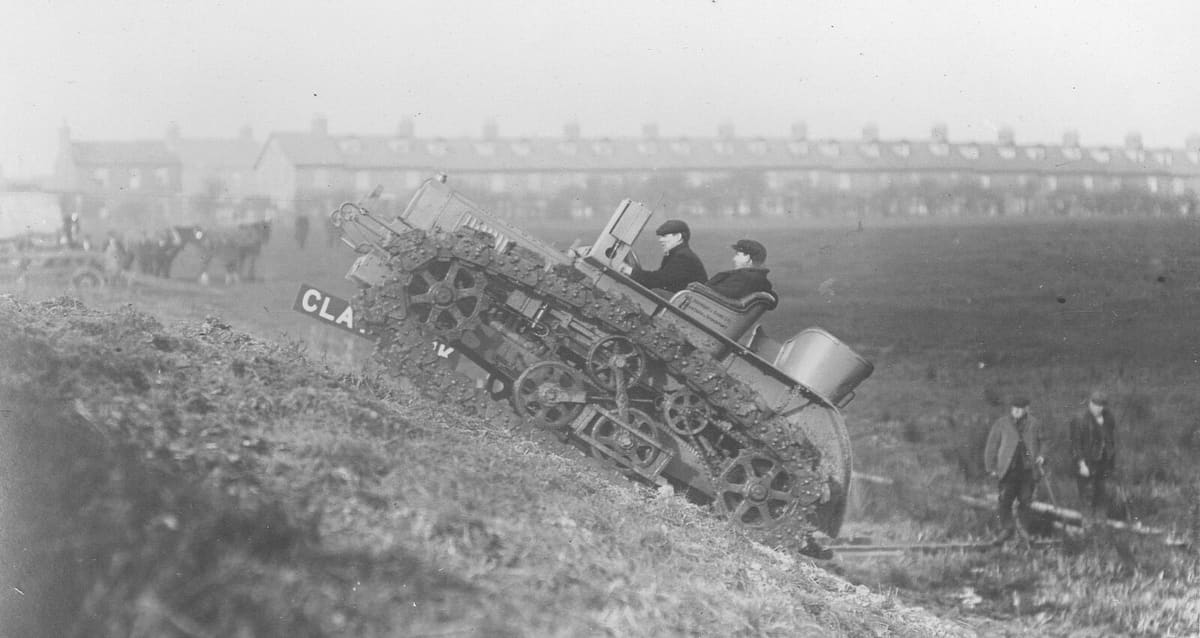
Instead of running on wheels that sank into soft ground, Roberts' machine laid its own continuous track of linked plates beneath itself, spreading the weight and letting it cross ground that stopped conventional wheeled tractors dead. Roberts began demonstrating the machine to the British Army's Mechanical Transport Committee from around 1905.
A formal demonstration at Grantham in February 1906 saw the crawler outperform a wheeled tractor. Improved versions were then tested at the Army's headquarters at Aldershot, where in 1908 the Hornsby crawler received its highest accolade: a demonstration attended by King Edward VII himself. Hauling a trailer with a dummy gun aboard, the tractor climbed banks, crossed ditches and handled rough ground with ease. The display became national news.
The Army bought a small number of machines, with four heavy-oil tracked tractors delivered to the War Office by 1910. But the orders never grew beyond a trickle.
Lost Opportunity
For all the admiration, the crawler simply never found a market. Roberts had spent around five years developing it and, by his own account, barely covered his costs from the fees the Army paid for trials. Neither military nor civilian buyers came forward in the numbers the project needed, and by the end of 1913 the firm had grown thoroughly disillusioned with an invention that had brought prestige but no profit.
Shortly before the First World War, Hornsby sold the chain-track patent rights to the American Holt Manufacturing Company for £4,000.
The Caterpillar Legacy
Holt would later become the Caterpillar Tractor Company in 1925, after merging with the C. L. Best Tractor Co. The name itself traces straight back to those early Grantham trials: "Caterpillar" was reportedly coined by onlookers who said the tracked machine crawled like a caterpillar, a remark variously credited to a Holt photographer and to watching soldiers. Benjamin Holt registered it as a trademark in the United States in 1910.
Within about a year of buying the patents, Holt found the market Hornsby never could. With the outbreak of war, the War Office ordered Caterpillar tracked vehicles in volume.